



Astronomers have confirmed that one of the fastest-changing stars ever observed has entered a new stage of its evolution, offering a rare opportunity to watch a star's life unfold on human timescales.
Using the European Southern Observatory's Very Large Telescope (VLT) in Chile, researchers, involving scientists from The University of Manchester and The Valongo Observatory, studied Sakurai's Object, a rare 'born-again' star that unexpectedly burst back to life in 1996 after reaching the final stages of its evolution.
Their findings, published today in Monthly Notices of the Royal Astronomical Society, show that the star has entered a new phase of its evolution, developing the powerful stellar wind characteristic of Wolf-Rayet stars.
The research provides new insight into the final stages of stellar evolution and helps astronomers test theories that would otherwise take thousands or millions of years to verify.
Professor Albert Zijlstra, from Jodrell Bank Centre for Astrophysics at The University of Manchester, said: "Most stars evolve so slowly that major changes take place over timescales far longer than a human lifetime. As a result, we usually have to piece together snapshots of stellar evolution by comparing different stars at different stages of their lives.
"Sakurai's Object offers something far rarer. It is one of the very few stars known to have changed dramatically within just a few decades, giving us the opportunity to watch stellar evolution unfold in real time. Thirty years ago, the star had a temperature similar to our Sun. Now, it is five times as hot, the fastest rate of increase ever seen.
"With our observations, we can test theories of how stars evolve and gain new insights into one of the shortest and least understood phases in the life of a dying star."
The scientists believe the star was similar to our Sun, but had already ended nuclear burning and begun its journey towards becoming a white dwarf - the hot, dense core left behind after an ordinary star dies. It underwent a rare event known as a "very late thermal pulse", when a layer of helium deep inside the dead star suddenly reignites.
The event caused the star to rapidly expand, cool and eject large amounts of material into space, temporarily returning to an earlier stage of its life, leading astronomers to describe it as a "born-again" star.
Only two stars have ever been directly observed undergoing this type of dramatic rebirth: Sakurai's Object and V605 Aquilae.
Following its outburst, Sakurai's Object became hidden behind thick clouds of gas and dust released during the eruption, making it difficult to study directly.
To investigate its current state, the team analysed light collected by the VLT and compared it with sophisticated computer models that simulate the atmospheres and powerful winds of Wolf-Rayet stars.
The observations revealed distinctive signatures of carbon and helium, allowing the researchers to find its temperature, chemical composition and the characteristics of its stellar wind.
Their analysis suggests the star's surface temperature is currently between around 27,000 and 36,000 degrees Kelvin, showing that it is reheating following its dramatic eruption nearly three decades ago.
Professor Zijlstra added: "One of the key questions is how quickly Sakurai's Object should recover after its dramatic eruption.
"Our measurements show that the star is reheating more gradually than some earlier models predicted. That gives us an important way of testing which theories best describe what happens when a dying star briefly springs back to life.
"As we continue to monitor the star over the coming years, we expect to learn much more about this remarkable phase of stellar evolution."
The findings also suggest that Sakurai's Object is at an earlier stage of its evolution than V605 Aquilae, which experienced a similar event around 80 years ago.
The team will continue observing Sakurai's Object as it continues reheating and resumes its journey towards becoming a white dwarf, learning more about one of the most rapid and unusual phases of stellar evolution ever observed.
ENDS
Media contacts
Sam Tonkin
Royal Astronomical Society
Mob: +44 (0)7802 877 700
Jessica Marsh
The University of Manchester
Mob: +44 (0)7780 281312
jessica.marsh@manchester.ac.uk
Science contacts
Professor Albert Zijlstra
The University of Manchester
albert.zijlstra@manchester.ac.uk
Images & captions
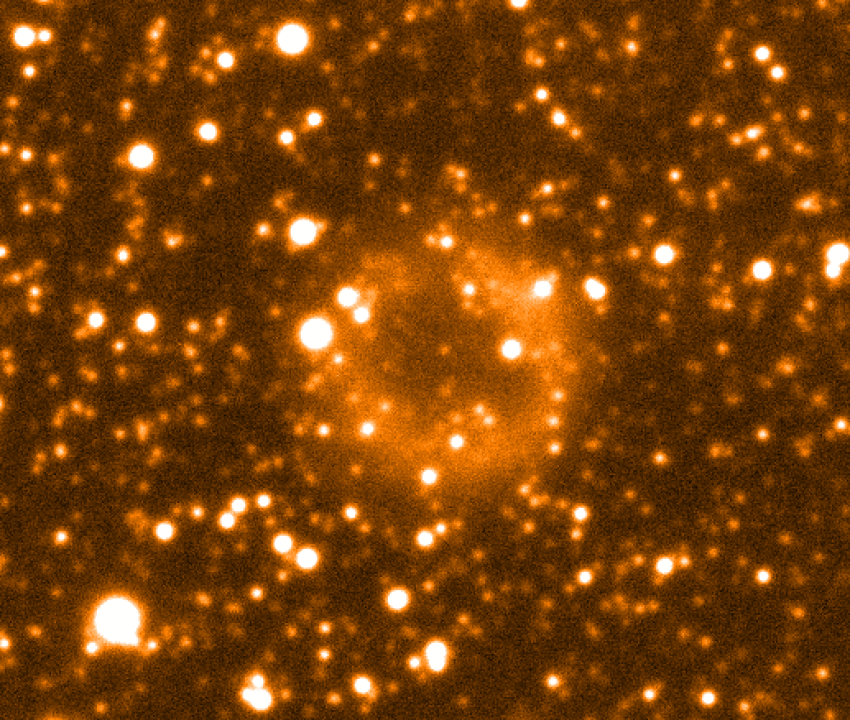
Caption: This image captures the ancient planetary nebula ejected by Sakurai's Object when the star died for the first time. The star itself is not visible, as it was captured before it began brightening again.
Credit: ESO, 2004
Caption: A still image of the animation showing Sakurai's Object as it was captured three years ago.
Credit: Peter van Hoof
Further information
The paper 'The emergence of a [WC] star in Sakurai's object' by Marcolini et al. has been published in Monthly Notices of the Royal Astronomical Society. DOI: 10.1093/mnras/stag1533.
Notes for editors
About the Royal Astronomical Society
The Royal Astronomical Society (RAS), founded in 1820, encourages and promotes the study of astronomy, solar-system science, geophysics and closely related branches of science.
The RAS organises scientific meetings, publishes international research journals, recognises outstanding achievements by the award of medals and prizes, maintains an extensive library, supports education through grants and outreach activities and represents UK astronomy nationally and internationally. Its more than 4,000 members (Fellows), a third based overseas, include scientific researchers in universities, observatories and laboratories as well as historians of astronomy and others.
The RAS accepts papers for its journals based on the principle of successful peer review, following which experts on the Editorial Boards accept the papers for publication. The Society issues press releases based on a similar principle, but the organisations and scientists concerned have overall responsibility for their content.
Keep up with the RAS on Instagram, Bluesky, LinkedIn, Facebook and YouTube.
Download the RAS Supermassive podcast